


Spring First Aid
March 25th, 2014
Normally, this is spring cleanup time in the landscape.
This year – at least in my yard – it’s more like spring first aid.
I finally got out in the past week to assess the snow and cold carnage, and it’s not pretty… not disastrous, but things took more of a beating than usual.
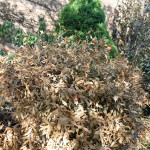
A lot of broadleaf evergreens are browned around the edges – “winterburned” from the cold wind.
The boxwoods, some of the azaleas and rhododendrons, my pyracantha, the cherry laurels and especially the nandinas and my precious variegated ‘Goshiki’ osmanthus all have varying degrees of leaf-browning.
I think these will come out fine once new buds push. I just got done trimming off much of the wind-damaged foliage and some brown branch tips. Eventually, the remaining brown leaves will drop.
The nandinas looked the worst, but they can take severe cutbacks and come out looking good as new by June.
I’m a little more concerned about the osmanthus. The leaf color just doesn’t look good even down into the inside of this borderline Zone 6 plant. The branches are pliable, though, so I think even it is going to be OK. It’s letting me know it’s not a fan of zero degrees, though.
A bigger long-term problem is the lawn.
Those dratted, tunneling voles did a fair amount of damage under the winter-long snow cover, which protects them from flying predators.
I raked the dead grass out of the tunnels and will get new grass seed down once the soil warms up a bit – probably around the second week of April this year.
Some of my ground is still partly frozen an inch or so down. No sense trying grass seed yet.
Even worse is the lawn damage that I’m seeing from grubs.
All of my lawn is still mostly brown (no fresh green growth yet this year), but there’s a difference in appearance between grass that’s brown and dead and grass that’s brown and dormant. The dead grass looks browner.
Grub-killed grass not only is brown this time of year, but it pulls up readily like a tuft of unsecured carpet when you rake it. That’s because the lousy grubs chewed the roots out from under it last fall.
Grubs are deeper in the soil now and not doing any new damage. So that’s why you won’t see them if you pull up the dead mats as you do in fall.
They’ll come closer to the surface and resume feeding for a few weeks later in spring before turning into adult beetles and emerging to mate.
Treating does no good now. All we can do at this point is remove the dead grass and plant new seed when the soil warms.
I’ve also spent some time raking leaves off the semi-evergreen perennials and groundcovers – things like helleborus, creeping sedum, coralbells, foamflowers, foamybells, lamium and my strawberries.
I’ve also been cutting down browned-out perennials, most of which I let stand over winter as crown insulation, as seed sources for birds and as shelter/nesting material for overwintering beneficial insects.
That raised an interesting question I got from a reader last week. How soon is it OK to cut and remove this foliage? If we get too “clean” too quick, aren’t we wiping out beneficials at the last minute before they’ve had a chance to hatch?
The short answer is that hatch times vary from year to year (later this year) and from species to species. Most are out and around by April.
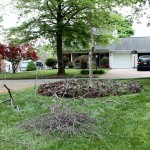
But if you’re raring to whip the yard into shape before then, one option is to temporarily stash stems and leaves with unhatched beneficial chrysalises, spider egg sacs, mantid cases and the like in an out-of-the-way area.
Do you have a wooded area nearby, for example? How about an out-of-the-way corner where you can make a shallow pile? Or maybe you can tuck some of it underneath trees and shrubs?
Otherwise, place stems with unhatched sacs and cases on the top of your compost pile.
What you don’t want to do is bury egg-laden material so deep anywhere that you’ll impede hatch.
The more you’re familiar with what these beneficials look like, the better. A beneficial-insect guide book or Internet search can help with that. One of my favorite bug-ID sites is BugGuide.net.
Check back next week, and I’ll go over some other yard jobs you could/should be doing.


George, for grub control, what about applying milky spore now? Since the damage is very clear, placement of the spores would be very accurate. And wouldn’t the grubs eat the BT and never turn into adults?
Sarah,
You can apply milky spore disease in the spring, but it takes 2 to 3 years for the pathogen population to build up to the point where it becomes effective. You wouldn’t see a quick kill and probably wouldn’t get much (if any) control of the current grubs. As with chemical controls, mature grubs in April and May are better able to fight off a milky-spore infection.
This also assumes the grubs are Japanese beetle grubs. Milky spore only affects that type. We also have masked chafer and Oriental beetles that become lawn-root-chewing grubs. The grubs look very similar.
I look at milky spore as more of a long-term measure that’s had mixed results in the field.
George