




The Verdict of Another Rough Winter
May 19th, 2015
I was expecting the cherry laurels and nandinas to brown out from the cold winter wind.

My dead ‘Prairifire’ crabapple on the way down and out.
I was expecting the crape myrtles to die back to the ground and the hydrangea flower buds to take another beating.
What I wasn’t expecting was for my 20-year-old ‘Prairifire’ crabapple to die in the front yard.
Crabapples are reliably hardy here, even in colder-than-usual winters. And this one was fully acclimated to the site and doing well enough that its blooming glory made the cut as the cover shot on my “Pennsylvania Getting Started Garden Guide.”
Now all I have is a skeleton of dead sticks, the book photo, and the memories of Mays past.
I’m far from alone in mopping up after another damaging winter.

My ‘Prairifire’ in happier times.
From the reports I’m getting and the yards I’ve been seeing, our woody plants took varying degrees of hits.
By and large, perennials and groundcovers came through winter without incident, likely because of the insulating effect of the nearly winter-long snow cover.
But trees, shrubs and upright evergreens had no such protection, so the less winter-tough ones took the brunt of those many zero-degree nights and branch-numbing winds.
As you might guess, the borderline-hardy stuff generally took the worst beating.
All of my crape myrtles, for example, have nothing but brittle wood above ground. On the plus side, some are pushing new growth from the base, which means they’re alive but basically starting over.
Ditto for my hardy camellias, which weathered winters nicely for 15 years with only some minor leaf browning and windburned flower tips in some years. Then the winter before last killed everything except the trunks, and this past winter killed off last season’s twiggy growth that valiantly tried to resurrect the southern belles. I’m seeing just a few new green buds so far.
Broadleaf evergreens such as cherry laurel, nandina, leucothoe, boxwood, euonymus, sweetbox and even some hollies and azaleas came out of winter looking more like “everbrowns” in some yards. Ones out in the open fared worse than ones protected by house walls and courtyards.
While the broadleafs still might look pretty bad, most will recover. So long as just the leaves browned from the cold wind and the branches remain alive, the plants will slough off the brown foliage as new leaf buds push out and open.
I’m more surprised and less optimistic about some of the still-bare branches on species that usually don’t suffer much winter damage.
Two in particular are Japanese maples and cherries.
I’m hearing about and seeing random dead branching on those two species, both of which should have leafed out fully by now.
That’s a bad sign, especially if you try to bend the bare branches and find that they’re brittle and snapping off and showing no sign of green just inside the bark.

I’m seeing a lot more dieback on usually winter-hardy shrubs such as sweetspires this winter.
I’m also seeing a lot of dead branch tips on bigleaf hydrangeas, which could spell another June with diminished or no flowers since the bulk of flower buds form toward the ends of these branches.
And I’m seeing more branch dieback than usual on butterfly bushes, Virginia sweetspires, St. Johnsworts, Leyland cypresses and shrub roses.
If this wood is dead, all you can do is cut it off and hope there’s enough life left in the plant that it’ll fill in and eventually recover into some semblance of a nicely formed specimen again.
Up until last spring, I would’ve said that everything that’s coming back to life would be back to life by the end of May. But since some apparently-dead plants were still leafing out for the first time as late as the end of June last year, I’d now say give your apparent-deads until then before getting out the shovel.
Once you’re sure branch tips or whole branches are dead, prune them off – back to live growth. This may involve cutting whole branches back to the trunk, or in the case of crape myrtles, pruning back everything to where new shoots are emerging from the base.
After getting rid of dead wood, it’s OK to prune surviving wood to make the plant look reasonably shaped again. Try to limit that as much as possible since these winter-whacked plants can use as many sun-grabbing leaves as possible to generate energy to regrow lost limbs.
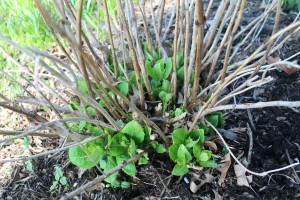
Once you’re sure branches or branch tips are dead, prune them off. Here, only new basal growth is emerging from these hydrangeas.
If everything above ground is dead and there’s no sign of shoots emerging from the base by the end of June, think about what you’d like to replant in honor of the botanically deceased.
I should mention that not all of the current plant mayhem is due to winter cold.
I got a question last week from a reader wondering why his junipers are almost dead, even though he wrapped them with burlap over winter. Junipers are generally very winter-hardy and don’t even need burlap in winter.
I think the answer is that the dead branches are due to voles eating the roots out underneath. Voles not only apparently enjoy the taste of juniper roots and bark (at least when there’s not much else available to eat), but they like the protection from hawks offered by evergreen juniper foliage overhead.
I’ve had voles kill entire juniper bushes in my yard from eating roots in winter as well as stripping the base of the trunks. They’ve also killed an apple tree and a rose bush in my yard from winter root-feeding.
And if you think deer damage in the landscape was worse than usual this winter, you’re not imagining it.
Several of my Garden House-Calls clients have pointed out assorted worse-than-usual damage, including eaten plants near the front door and in beds that deer never bothered before.
The likely explanation is that deer had less to pick from due to the snow cover, so those landscape hollies, arborvitae, yews and azaleas looked even tastier than usual.
At least warm weather is finally here and enough IS blooming and looking good to help us forget about January. We should be good now for at least 5 more months.
Then, what are the odds that we’ll have three plant-punishing winters in a row?

George - great article! It’s interesting about the crape myrtles - I also live in Hampden Township and have “Sarah’s Favorite”, a white tree-type which is reportedly the most stem hardy variety, down to -12 F. I have it planted on the north side of my home and it experienced no dieback this past winter. Now, my “Dynamite”, a red medium-sized variety, is only stem hardy down 0 F and was killed back to the ground the past two winters. It is currently resprouting. My “Tuscarora”, a watermelon-pink tree-type, was only stem hardy to +5 F and was completely killed this past winter, after resprouting reliably the past five springs. There are three “Pink Velour” crape myrtles planted on Jerusalem Road and one “Hopi” crape myrtle on Silver Creek Road which never have significant dieback (all are near Aldersgate church). There is a true, tree-size (about 25-feet tall) pink crape myrtle on the corner of Creekview Road and Good Hope Road that is coming into full leaf now. There are also some nice tree-sized ones along Orrs Bridge Road (“Acoma” is one of the varieties) that have come through the last two winters unscathed. None of these are particularly protected in any way. There used to be a “Crape Myrtle Hardiness Chart” available online which listed the absolute minimums the different varieties had been tested to in PA. There were around five commonly available varieties that were stem hardy to at least -5 F, with some down to -10 F or below (e.g. “Sarah’s Favorite” and “Hopi”).
Also, my five hardy gardenias (“Frostproof”, “Crown Jewel”, and “Double Mint”) all came through the past two winters just being buried in leaves and some snow. They bloomed well last summer. My “April Remembered” and “Winter’s Star” hardy camellias also came through, but with significant dieback.
Such valuable information! Thank you! I’m going to be more patient with my young butterfly bushes before replacing them. Fingers crossed!
My figs are struggling. Last spring, I had to cut them to the ground (first time ever) and they came back nicely, but didn’t produce many figs. This year, I decided to wait a bit longer, and although they’re getting some leaves at the bottom, there’s not much activity happening at all towards the limbs.
We lost our 10-year-old Eastern Redbud and I was heartbroken. Now I have a better understanding of what happened to it. Thanks for a timely article, George.
Don’t dig up your crape myrtles yet. Last year I didn’t see any green until July. This year I do have shoots coming up from the bottom and they appeared early in May. They look pretty healthy now. Also my butterfly bush looked dead last year and when I went to cut it back, there was green just under the ground. It came through this winter fine and is loaded with buds although shorter than it had been before last winter. It needed to be cut back anyway.
Thank you George! What a useful and informative column about winter damage!
It was so helpful to know what to look for in our crape myrtles. My established ones are are all starting to grow from ground-level this year. Two small new ones, that I bought on fall 2014 clearance, have no sign of green - likely were too small to survive that severe winter in their new homes. I had been wondering when to cut off the old wood and now I know.
I have a teeny-tiny Japanese Red Maple Corolinum that has grown no bigger since I planted it 7 years ago - thanks to regular mouth-pruning by our resident deer herd. It miraculously survived the winter - to be chewed-on another year!
I do believe gardeners have to be the most optimistic people on the planet!
Thanks for keeping our spirits up! Sorry about your beautiful Prarifire tree.
Hi George, I agree with the others. Your columns are always so timely and very helpful. Interesting about the voles. I have to say, though, you forget to mention the blankety-blank RABBITS. They ate my New Jersey Tea right down to the ground along with two new Oak Leaf Hydrangeas before I realized what had happened. I didn’t have to cut back my ‘Little Princess’ Spirea this year. They did it for me. They made my Nandina ‘Firepower’ look like mushrooms, and ate all the leaves off the bottom branches of the Holly. I live in Lake Meade where it is slightly colder than the West Shore. I lost two large Arizona Cypress ‘Blue Ice’ along with my Cherry Laurel - not just brown - very dead. I am replacing them with Ninebark and Spruce. My Crape Myrtles are showing no signs of life. One is the ‘Veleor’.
Hi Barb,
Gardening in central Pennsylvania is never easy! So many things can (and do) go wrong. I think animal damage in general was worse than usual this winter because of the snow cover. The bunnies, deer and friends turned to woody plants when they couldn’t find anything else green.
Sorry to hear about the cypress, cherry laurel and crape myrtles. It’s getting kind of late now for signs of life, but you never know. Miracles happened as late as the first week of July last week…
Susan,
We’d better be optimistic or else gardeners would be the most frustrated people on the planet!
Joanne,
Right, there’s no need to rush things and dig up plants that may yet pull off a miracle. I used to think end of May was our “drop-dead” date, but after seeing shoots emerge on a fig the first week of July last year, I moved my patience date back. I think we’re back to more normal timing this year, but you never know…
Jane,
May your redbud rest in arboreal heaven next to my Prairifire…
Mary,
I’m seeing lots of new growth on my fig toward the bottom. A couple of stems appear to be dead completely, but all of the stems have nothing going on toward the tips. I’m going to wait a few more weeks (just in case), and then clip back any bare wood around the end of June. Letting the apparently dead tips on awhile longer won’t hurt anything…
Kim,
Patience is a virtue… especially with butterfly bush, crape myrtle, cherry laurel, nandina, camellia, etc. etc.
Hylton,
Thanks for the crape report. I’ve never tried ‘Sarah’s Favorite.’ Sounds like that one’s an especially good bet for our area.
I think with all of these borderline-hardy shrubs, site placement is so critical. An ideal location with just a degree or two extra warmth or wind protection can make the difference between life, death and disfiguring dieback.