


2014 Garden Mayhem Outlook
March 17th, 2014
Before that garden in your mind starts looking too optimistic, now’s a good time for a status report on pesky gardening news to keep you from getting too cocky:
* Bugs and Cold
Let’s start off on a good foot with the potential damage that winter’s cold and wind did to the bug population.
You might’ve heard the report that “90 percent of the stinkbugs died off over the winter.” That’s not exactly true, but entomologists are saying that maybe 50 percent of the stinkbug population may have been knocked back by those nights that flirted with the zero-degree mark.
Woolly adelgids, gypsy moths and possibly bagworms are three other common havoc-causing landscape bugs that may have taken an even bigger hit.
Ticks and emerald ash borers? Probably not so much.
I just got writing a more detailed piece on this whole “Don’t Kiss the Stinkbugs Goodbye Yet” topic, which you can find on my Gardening News page.
* Boxwood Blight
2014 could be a pivotal year for that new boxwood disease that’s officially on our doorstep in Cumberland County.
Early symptoms of blight are showing on this boxwood in a photo by Sharon Douglas of the University of Connecticut.
Penn State Extension in Carlisle got a boxwood sample last spring that tested positive for boxwood blight, a deadly fungal disease that’s spread to 10 states in the last two years. It’s also been found in two plants in Lancaster County and one in Chester County.
What’s the outlook? The disease isn’t rampant enough to warrant avoiding new boxwoods, but you may want to think twice before adding new ones to a landscape that has existing boxwoods that you don’t want to risk losing.
Bringing in infected plants is thought to be the most likely way of spreading blight, followed by moving around infected clippings (boxwood Christmas wreaths, for example) and moving infected soil or pots.
The nursery industry is hoping to contain the disease by inspecting boxwoods closely before they head out into the retail pipeline.
And researchers already have identified boxwood varieties that seem to be blight-resistant.
According to North Carolina State University plant pathologists, ‘Green Beauty,’ ‘Nana,’ ‘Golden Dream,’ ‘Winter Gem,’ ‘Dee Runk,’ ‘Fastigiata,’ ‘Green Gem’ and ‘John Baldwin’ are among the most blight-resistant types.
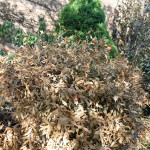
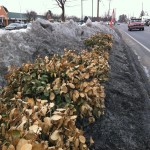
Boxwood blight starts with concentric brown spots on the leaves and black streaking on the stems. Soon after, the leaves turn straw brown and start dropping.
Plants try to re-leaf, but after two or three years of that cycle, they often croak.
Several other problems can brown out boxwoods, so don’t hit the panic button just because you notice brown leaves. Winterburn caused by cold, dry, winter winds is fairly common in late winter, especially in years like this.
If you suspect boxwood blight, contact either the state Department of Agriculture or Penn State’s Plant Disease Clinic for instructions on getting a diagnosis.
Read more about boxwood blight in a Pennlive column I wrote last spring.
And for tips on recognizing and heading off blight in your landscape, see a Pennlive garden Q&A from December.
* Poison Hemlock
We can only hope that the cold also knocked back some of the weed problems we’ve been having of late.
The warming climate with its lower oxygen levels has been one of the contributors behind the “weed creep” of species that didn’t normally survive in Pennsylvania. Kudzu – the “vine that ate the South” – is an example of a weed that’s been elbowing its way here.
One oldie-but-baddie weed that Penn State weed scientist Dr. William Curran says proliferated big-time statewide last summer probably isn’t going to be impacted significantly by the winter’s cold – poison hemlock.
This is the same weed whose juice killed Socrates, so it’s been around awhile.
Poison hemlock is a carrot-family plant that grows at least 4 feet tall and has hollow, tubular stems with purple blotches over them. The leaves are finely dissected like carrot leaves, and the plant puts out white, umbrella-shaped flower clusters in early summer.
Besides its propensity to spread, poison hemlock is a problem because it’s, well, poisonous. All parts of it are deadly enough to kill if eaten in enough quantity. So this is definitely one weed you’ll want to remove if you have children, pets or livestock around.
Last year’s bad outbreak poses a repeat threat this year because poison hemlock spreads by seed. It’s a biennial that grows without flowering or seeding in its first year, then seeds and dies in its second year.
* Next Bug Pest
The cold might’ve slowed the advance of a new bug pest that has been working its way toward us – the “kudzu bug.”
This is a stinkbug-like creature about the size of pencil eraser, speckled dark brown in color and smelly when crushed.
Unfortunately, it doesn’t just feed on kudzu vines. It has soybean farmers particularly on edge (that crop is a favorite), but it also feeds on corn, beans and most other legumes.
Like the brown marmorated stinkbug, kudzu bugs have the annoying habit of working their way inside our houses to escape winter weather.
Kudzu bugs have been found as far north as Maryland. They’ve been working their way northward from Georgia since 2009 and are thought to be capable of surviving in the same regions as the stinkbug, which has plagued Pennsylvania for nearly a decade.
You know a bug has arrived when it has its own web site, which this one does. Those polar vortexes at least might have given us a reprieve.
* Bagworm Woes
Are you seeing what look like little brown cones hanging all over your evergreens?
Those are likely the cases of another bug that had a banner year across Pennsylvania in 2013 – the bagworm.
Bagworms are caterpillars that chew on needles and leaves over the summer. Those cases you’re seeing bear the eggs of what could hatch into a potential worse problem.
I say “could” because it’s possible that the cold has knocked back this pest. Although no one has done an official check that I know of, entomologists are guessing bagworms took a decent hit because those egg cases are on branches and exposed to winter cold and wind.
If you’re not sure and have the time and motivation, use a pair of scissors or pruners to snip off the bags sometime in the next few weeks. The bags are very noticeable now because they’re brown – not their in-season, camouflaging green color.
Note: The eggs are only in the female bags. That explains why you’ll find some cases empty and others filled with more than 500 little bagworm eggs.
If you can’t or don’t remove the bags, keep an eye out for egg hatch in late May to early June. Look closely for tiny caterpillars nibbling the needle tips and building new cases, which start out small and green and progress to thumb-sized and brown by fall.
Infestations that happen despite the winter’s cold can be controlled by spraying the plant with either Bacillus thuringiensis (Bt) or spinosyn (Spinosad) as soon as you notice the young-‘uns – ideally before the end of June.
Bagworms especially favor arborvitae, juniper, pine and spruce, but they’ll also feed on leaf-dropping species, such as crabapple, maple and sweetgum.



Good Day George !
Was reading your article on boxwood blight and did’t see my variety of “Green Velvet” mentioned as one that may be more resistant to it.
Do you have any information of them ?
Thank you and HAPPY SPRING !!
Debbie
Debbie,
‘Green Velvet’ was included in North Carolina State University’s blight-evaluation study, and it ranked as “moderate” in infection risk. It wasn’t as blight-resistant as a few of the best, but it did better than about two-thirds of the other varieties tested.
Here’s a link to the full rankings: http://plantpath.cals.ncsu.edu/sites/default/files/u21/Ganci-cultivar-summary-2013.pdf.
George