
Bottom 10 Shrubs
September 27th, 2013
Now that you’ve got my list of Bottom 10 Annuals and Bottom 10 Perennials, it’s time to finish off this series with my Bottom 10 Shrubs.
I’m not saying you should never plant any of these, and it doesn’t mean I hate them. So don’t get mad if your favorite shrub made my “wouldn’t-plant-again” list.
Feel free to add your own non-favorite shrubs by using the comment button below.
Here goes… my Bottom 10 Shrubs for central Pennsylvania:
1.) Mountain laurel (Kalmia). I can’t grow one of these to save my life, and from what I’ve seen in hundreds of other yards, neither can you. Our state flower does fine in the woods when its seed finds a site to its liking. But in our baked-clay yards, it suffers and croaks most of the time.
2.) Heath/Heather (Erica/Calluna). When Longwood Gardens gave up trying to grow these, I knew it wasn’t just me. Heaths and heathers manage to grow in nearly solid rock and other horrific sites so long as the conditions are acidic and free from wild temperature extremes. They do exceedingly well in Scotland and England, but we often get shades of Alaska in winter and weeks worth of Dallas in summer. In other words, we’re not Scotland. Some people manage to keep these alive. Not me.
3.) Burning bush (Euonymus alata). Yardeners love this common shrub for its fire-engine red foliage in fall. In my experience, that lasts about 3 days before the leaves blow into the gutter. The trait that turns me against the burning bush, though, is its bad seeding manners. Gobs of unwanted babies can pop up most anywhere, including in untended areas where they can choke out native and more enviro-useful vegetation.
4.) Barberry (Berberis). Solid clay, parking-lot heat and driveway salt runoff don’t faze this hard-to-kill rounded shrub with the thorns. The compact, burgundy-leafed forms are planted everywhere as a result. I’m not keen on those sharp thorns, but like burning bush, barberry is high on the rampant-seeder list, although a few varieties are nearly sterile.
5.) Rose-of-sharon (Althea). I know a lot of you like this tall shrub for its durability and long-lived flowering. To me, it crosses the line into misbehaving seeder. Too many babies come up in unwanted and invasive situations for me to give it a pass. Sometimes they also get too big for their settings and “bare out” around the legs.
6.) Azalea. Sorry, again. I know this is one of our most beloved and planted shrubs, and I really do like them in bloom. The problem is a bug – the lace bug, to be exact. Azaleas are magnets for this juice-sucking bug, leaving so many of them looking a stippled straw brown by season’s end. Azaleas also have a very high initial death rate due to low tolerance for clay soil, wet soil and drought. They really despise the full sun and “builder’s soil” they so often get thrust into.
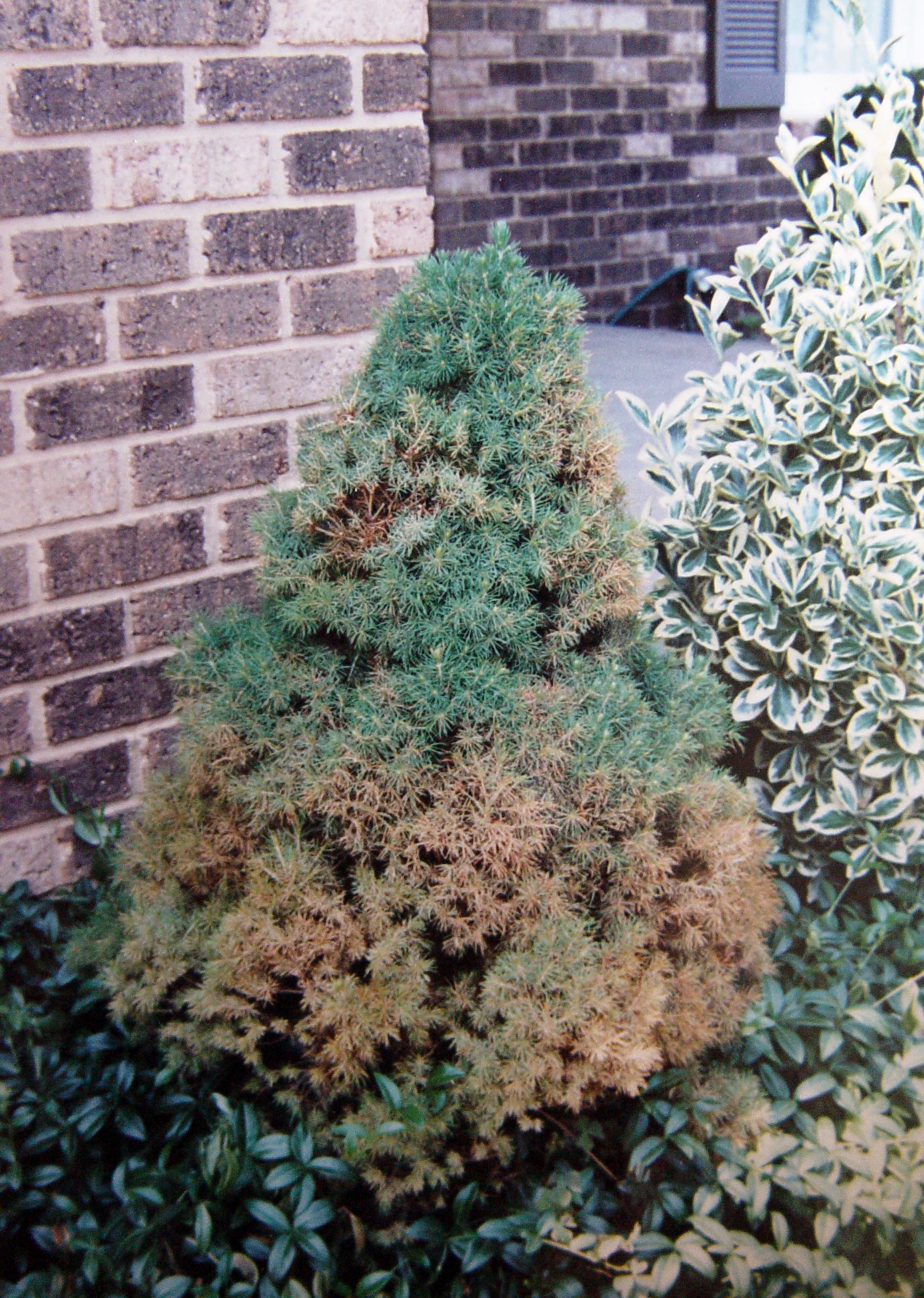
7.) Dwarf Alberta spruce (Picea alba). This top-selling, slow-growing, pyramidal evergreen flanks so many front doors, but it gives the azalea a run for the dishonor of being the most-killed landscape shrub. Spider mites brown out enough sections of dwarf Alberta spruce to ruin the look, and if not treated, they eventually can kill the whole little tree. Mites are such a common pest here that it’s really not a question of whether your dwarf Alberta will get them, but when.
8.) Variegated euonymus. Like gazillions of rookie gardeners, I was drawn to the bright, variegated foliage of these broadleaf evergreen shrubs. So I bought five for out front. The first year, rabbits gnawed them to the ground. But they grew back. The next year, they got white specks that turned out to be a bug called scale. I learned the bugs were potentially deadly and sprayed to control them. The next year, they were back. I soon caught on that this was going to be a regular occurrence (which it is, from what I see in so many other gardens). So I yanked the five plants and replanted with spireas, which have had no issues in 20 years. Not all types of variegated euonymus always get scale, but it happens enough that I’ll take my chances with something else.
9.) Mugho pine (Pinus mugo). Other than the frequently mispronounced name (it’s “MYOO-go,” not “MUG-ho”), this stiff-needled evergreen is also a big draw for scale. This bug happens to be one of the Big 3 landscape-plant killers (along with lace bugs and mites). I’m not that fond of the coarse texture and prickly feel of mugho pines either, but that’s subjective. Too many better choices…
10.) Pyracantha. This is the fast-growing plant with the orange winter berries and long, stiff thorns. My late parents bought me one of these as my first landscape plant, which I’ve got trained up my chimney. So I don’t have the heart to get rid of this particular pyracantha, which should be classified as a deadly weapon. It bloodies me every pruning, despite big gloves and wary care. I just hope it never gets me in the eye. I also have trouble with a fungal disease rotting the fruits before they turn that showy orange in fall.
I should also mention that Japanese holly has a high first-year death rate; I don’t like how inkberry hollies get bare bottoms and can’t grow uniformly; I see way too many Japanese pieris with root-rot issues and lace-bug damage (ditto for rhododendrons), and forsythia are 2-week wonders that get way too overgrown.
Also, even the so-called “disease-resistant” award-winning roses all get some degree of black spot disease in my garden (except for ‘Knock Out’ and ‘Drifts’).
Now that I’ve trashed so many woody plants, check out the Plant Profiles section of my site to see flowering shrubs and evergreens that I DO like.
And see my list of Bottom 10 Annuals and Bottom 10 Perennials.



I would definitely put Forsythia on the list. Granted, the yellow color is a classic harbinger of spring and also a time-marker for when to prune roses and ensure you’ve put down either corn gluten or chemicals for crab grass prevention. It’s just that it’s so over planted at this point. I can enjoy these in other people’s gardens at 60 miles an hour.
Also, for some reason, people seemed inclined to prune these into horrible meatball shapes. Even people who do absolutely nothing to their garden inexplicably prune their Forsythia. To make matters worse, they often do it in the fall and therefore get flowers on the old wood interior of the plant (ugly). It’s so much more attractive if given a huge amount of open space to let it take its natural graceful shape. It also loses points for having no fall color. Buy witch-hazels instead!
Steve
Steve,
You took the words right out of my mouth that I’ve uttered about forsythia numerous times. I couldn’t agree more — over-used, butchered and even then just a 2-week wonder. But people do love them in bloom…
The guaranteed forsythia trick: after it’s done blooming, cut it back HARD, 6-to-12 inches from the ground. It will be a gorgeous fountain of color next spring.
Well chosen lists, George, and your comments about heath, heather and Mt. Laurel made me feel not-so inept, and I couldn’t agree more about the invasive seedlings of Rose-of-Sharon and burning bush - many thanks!
Thank you George for your list of shrubs you dislike. Will be aware of these when shopping for plants. One thing to mention though, there are a few varieties of Rose-of-Sharon that are non-invasive. Have you tried any of them ? I want to put some in my yard in front of some Arbs & Cryptomeria. Pls advise.
Thank you.
Debbie
Deb,
There are a few supposedly a few sterile rose-of-sharons, but I’ve also heard reports from people who tried those varieties and found they still seeded around… maybe less so than some, but still not exactly sterile. So I have my doubts. I haven’t trialed them first-hand to see.