


Holly Dragon Lady
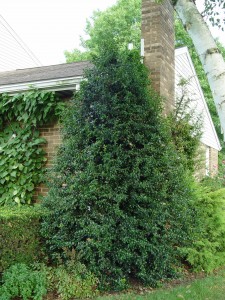
- Common name: Holly Dragon Lady(R)
- Botanical name: Ilex x aquipernyi ‘Meschick’
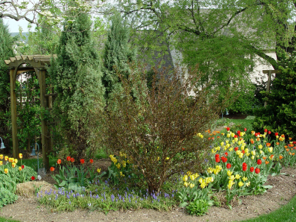
- What it is: A narrow, upright evergreen holly with dark blue-green leaves and pea-sized red berries in fall and winter when pollinated by a male holly such as ‘Blue Prince’ or ‘Blue Stallion.’
- Size: Grows about 15 feet tall and 5 feet wide in 10-12 years, but can be kept shorter or skinnier with an annual early-spring pruning.
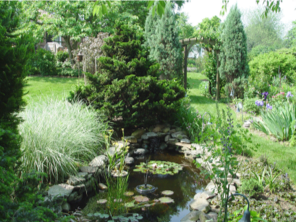
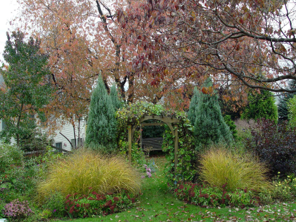
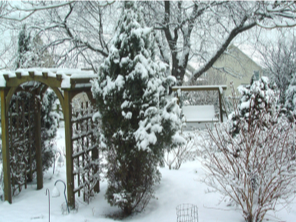
- Where to use: Makes an ideal evergreen specimen for house corners. Also useful for softening tall, windowless foundation walls; for flanking doorways, arbors or other entrances, and for hedging. Grows best in full sun to part shade. Just avoid soggy areas.
- Care: Likes acidy and well drained soils, so peat moss and/or compost with a little sulfur at planting time helps. Fertilize at winter’s end with an acidifying organic fertilizer such as Holly Tone or Holly Care. Prune, if needed, in March before new growth begins. Also can be lightly sheared or snipped for neatness through mid-summer. Option for windy areas: Spray leaves in late fall and again in mid-winter with an anti-desiccant such as Wilt Pruf or Safer No Wilt Plant Shield to prevent leaves from browning around the edges.
- Great partner: Most any bright golden perennial flower looks good in front of it, including daylilies, coreopsis, gaillardia and black-eyed susans.

Leaves turning lite yellow..need to know cause abd cure….thank you
Larry,
That’s likely a lack of iron and/or nitrogen. You could either test the soil to find out for sure or apply an acidifying fertilizer that contains sulfur and nitrogen. Usually there’s enough iron in our soil, but if the pH (acidity level) is too high (i.e. too alkaline), the iron doesn’t get dissolved and taken up by the plant. Products such as Ironite contain sulfur, iron and nitrogen — a trifecta that usually fixes yellowish holly leaves fairly quickly.
My question to you is , how do you propagate the dragon holly tree ? I tried air layering but it not working . Thank you Aldo
Aldo,
Try taking tip cuttings and getting them to root in a porous mix. The best timing is mid to late summer. If that doesn’t work on the first try, take cuttings a little earlier or later. Timing can make a big difference. So does keeping the medium damp.
Here’s a link to an article I wrote on starting plants from cuttings: https://georgeweigel.net/georges-current-ramblings-and-readlings/make-your-own-free-plants.
NC State University also has a good how-to page on tip cuttings at http://content.ces.ncsu.edu/plant-propagation-by-stem-cuttings-instructions-for-the-home-gardener.
Four weeks ago I had a dragon lady holly planted. It is about 4 feet tall and in a relatively sunny area. I’ve been watering it frequently but was away for 4 days and it was not watered. Now the leaves are curling and are brown around the bottom. It doesn’t look healthy. I don’t want to over water but its also very hot right now. What can I do to save it? How often should it be watered.
Thanks!
Carol,
It’s more challenging to establish a new plant when we’re at maximum daylight and in hot weather, and transplants are more at risk of shock like this.
Water is important but is just one issue. A deep soaking every 3 or 4 days is usually enough. That can vary, though, based on how well the soil drains, whether you’ve used mulch, how hot/dry it’s been, etc. Using your finger to check for dampness in the root zone next to the plant is as good a test as anything. If it’s dry, time to water. If it’s damp, wait. If it’s soggy, definitely do not water more. That occasionally happens and can cause wilting. Soggy soil can kill roots.
Even if watering is done well, new plants can wilt or drop leaves and even begin to fail from planting issues, such as planting too deeply, packing too much mulch up on the trunk, overmulching, damaging roots severely during the transplant and altering the conditions between what the plant was used to at the nursery vs. the light or different soil of the new site.
In other words, it takes some case-by-case detective work to know for sure. It’s not always a simple matter of not enough water. The good news is that if it’s a temporary planting-related shock as opposed to a longer-term problem such as too-deep planting, plants often wilt and/or drop and then adapt and grow a new set of leaves (or start to push new growth).
Thank you!
I’m interested in planting a privacy screen of Dragon Lady holly, but I’m concerned about the color of the leaves. How would you describe the green of new growth, as well as mature leaves?
(I have one cheerful holly that has leaves that are a shade of green similar to that of my grass. I also have one dreary holly that has leaves that are such a dark green color that they look almost black.)
Any insight into the Dragon Lady would be appreciated.
Paul,
I’d call the color dark green and glossy. A healthy Dragon Holly has a nice, rich color that’s darker green than grass. The new leaves are noticeably lighter — close to the color of grass — until they mature and darken.
These would make a nice privacy screen, unless they’re in a cold spot that gets blasted by winter winds. That wouldn’t kill them (at least not likely) but the leaves could windburn and/or brown in winter on the windward side.
Thank you, George!
I forgot to state that I live in coastal Massachusetts, zone 7a.