


Winter, Here We Come
November 24th, 2015
We’re in iffy territory now weather-wise with ice storms, freezes and, yes, even a plowable snow possible at any time.
The big question here at winter’s doorstep is just how bad things will get this time around.
The past two winters have been cold ones – enough to cause a fair amount of plant mayhem, likely made worse by the fact that our landscapes had adapted to a long string of warm winters.
Farmer’s Almanac-believers aside, who knows what we’re going to get?
If you’re an optimist or gambler or someone with only solidly winter-hardy plants in ideal locations, you’re probably doing nothing to “winterize” the landscape. And most of the time, our landscapes really do come out on the other side in reasonably good shape.
But if you’re pushing the envelope with borderline-hardy plants or one who goes into every winter fully expecting a vortex-laced snowmageddon, you’re more likely to feel like you ought to do something.
The two best somethings are burlap barriers and mulch.
Temporary walls of burlap stapled to stakes does a good job of deflecting cold winter winds, especially winds coming from the northwest and blasting broad-leafed evergreens such as cherry laurel, holly, nandina, osmanthus, boxwood and rhododendrons.
A few inches of leaves, bark or wood mulch over the ground helps insulate plant roots. West Shore fig grower Tim Clymer says he’s found that 6 to 12 inches of wood mulch (pulled back in spring) protects figs in winter as well as wrapping them.
Mulching and doing burlap barriers both is about as well as you can do, short of building a retractable roof over the yard.
Actually, there’s a third precaution that’s sometimes overlooked, says Annette MaCoy, the Master Gardener coordinator at Penn State Extension’s Cumberland County office.
“The best thing people can do heading into winter is to make sure that plants are well watered before the ground freezes, particularly evergreen plants such as conifers,” she says.
Fall rain keeps the ground damper longer than summer rain, and the November showers we’ve had were well timed. But continue to pay attention and do one last watering if things turn dry before the ground freezes for good.
MaCoy doesn’t do the wrapping thing. She says some people make little “huts” around their plants with burlap, tarps or chicken-wire cylinders stuffed with leaves, but she’s concerned that that also makes a cozy winter home for voles and other bark- and root-chewing rodents.
“That might mean a completely dead plant come spring instead of just a winter-damaged plant,” she says. “A blanket thrown over a plant on a particularly cold night might help on occasion.”
McCoy’s winter game plan is to “choose plants that are hardy to begin with, or find microclimates,” which are the little protected areas and warm spots that most yards have.
Seemingly minor siting differences can make a big difference in preventing winter damage. Don’t under-estimate the power of microclimates.
Michigan author and plant breeder Joseph Tychonievich just wrote on the Garden Professors blog about his experiment checking winter temperatures in three different parts of his yard.
He put min-max thermometers up in the air along a north-facing shed wall, another one at ground level along a south-facing shed wall, and a third one on the ground in the middle of an open area.
He assumed the warmest spot would be along the south-facing wall at ground level.
Not so. Although the daytime highs were a little warmer there, temperatures got as cold at night at ground level on the south side as up in the air on the north side.
From a tender plant’s point of view, that’s not helpful if the bottom-line temperatures are equally cold.
Tychonievich says he suspects a bigger benefit would be planting along a heated house wall where heat leakage would create a warmer microclimate.
My guess is that planting along south- or west-facing brick or stone walls would be more helpful than along a siding or wood wall because brick/stone would absorb daytime heat better.
The bigger surprise in Tychonievich’s thermometer experiment was how much warmer temperatures were under the snow.
He found that when a foot of snow blanketed the ground, his ground-level thermometer out in the open was 20 degrees higher than the air-exposed one. That’s a two growing-zone difference.
“I knew snow was a good insulator, but I didn’t realize it would make that big a difference,” he says. “I’m no longer trying to put tender plants against the south wall. Instead, I’m piling a layer of mulch after the ground freezes to augment the insulating power of the snow.”
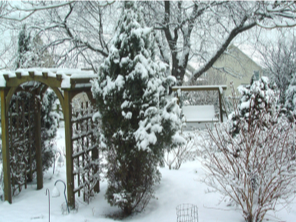
Snow isn’t always kind to trees and evergreens when it’s coming down (i.e. sagging and snapping branches from the weight), but once it’s safely on the ground around plants, it’s almost as good as a heated blanket.
MaCoy adds that proper pruning – starting when a tree or evergreen is young – is the best way to encourage strong branching and limit winter breakage.
One thing that pretty much all horticulturists and researchers agree doesn’t help much in winter-protecting is the step that many gardeners thinks helps the most – anti-transpirants.
Also known as anti-desiccants, these are oil- or resin-based sprays recommended to go on evergreen leaves and needles three or four times over winter to cut down on the windburn that browns the foliage. Common brands are Wilt-Pruf, Wilt Stop and No Wilt Plant Shield.
“Anti-transpirants are counter-productive, harmful and useless,” says MaCoy. “They interfere with transpiration and photosynthesis of evergreen plants by blocking the stomata (the plant equivalent of pores).”
Research hasn’t found them to be very effective at all in preventing the winter windburn that people buy them for.
It seems we’d be better off skipping the winter sprays and hoping for snow. I’m fine with part one of that, but I just can’t bring myself to wish for snow…

George,
Another great article! Thanks! This year, I’ve installed four (4) remote temperature sensors around my Hampden Township yard - one on the shaded, northern edge of my property (away from the house), one underneath my deck (but away from the house) which has tall-ish trees nearby, one on a bush on the south side of my house (about 3-feet from the siding wall), and one on the far south-western edge of my property. All are hung at approximately a 5-foot elevation from the ground. I’ve noticed the sensor on the south-western edge has the lowest readings and can be 5.5 degrees cooler than the one under my deck and near the tall trees. This could help solve the mystery of why my ‘Dynamite’ crape myrtle has been killed back to the ground the last two winters. The ‘Dynamite’ crape is supposedly stem hardy to -5 degrees F, and my former thermometer (which was at the location under my deck), only recorded winter lows of -2 F. If what I’m seeing with my new temperature sensors is correct, then the open location in my yard could have actually been closer to -6 or -7 degrees F - thus, being cold enough to kill off the top growth of my ‘Dynamite’!!
Talking about the usefulness of snow cover as a great winter plant insulator, I have five established hardy gardenia plants (comprised of gardenia ‘Crown Jewel’, ‘Double Mint’, and ‘Frostproof’) and all have survived for four years now by simply being mulched with shredded bark and then buried in deep snow each winter! They do get killed back some, but grow back vigorously each year. My ‘Double Mint’ and ‘Frostproof’ plants only finished blooming two weeks ago!
Another limitation with the anti-transpirants is the initial application/spraying only lasts so long and then they need to be re-applied. However, they are supposed to only be applied above a certain warmish air temperature - which has only occurred on one or two days over the past two brutal winters. Thus, if you weren’t able to be out re-applying them on those two particular warmish days, the initial anti-transpirant application wore off mid-winter and the plants were left unprotected…
Hylton,
Very interesting observations. You’re paying attention! And it’s excellent evidence showing what a big difference even minor adjustments can make in the landscape. A few degrees’ variation can either milk a borderline plant through winter or allow it to croak.
Also, good point about the practicality of anti-transpirants beyond effectiveness. It doesn’t help much to have to apply it only on above-40 days when the temperatures never come close to that for weeks on end.
Thanks for the helpful feedback…