
Christmas Colonial-style
December 21st, 2010
One of my favorite spots on Earth is Colonial Williamsburg – that little Virginia town that’s been restored to its 18th-century roots.
Our family took trips there almost every year when our kids were little. It was always fascinating to see just how people lived and thought back then – and you get immersed into it.
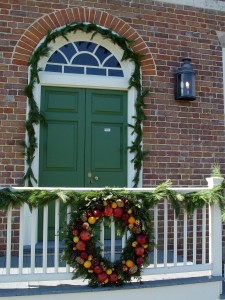
Williamsburg decorated au naturel.
We’d always gone there in spring or fall, though. We’d never seen the place decorated for Christmas until this year.
I can see why Christmas is such a big draw for Colonial Williamsburg. Besides the Grand Illumination kickoff weekend with fireworks, most Colonial buildings are decorated through New Year’s with boughs and wreaths made out of natural materials.
Wood fires are lit on the open ground and in hanging baskets each night to help stay warm and to light your way.
The wreaths were all different but all beautiful in their own way, from the simple pine rings with a single apple to truck-tire-sized wreaths adorned with a market basket’s worth of fruits.
I liked the wreaths with apples and pomegranates best. Also clever were the ones with oranges and lemons that had slits removed to dry and shrink the fruits. They reminded me of colorful little Whiffle balls.
Since Colonial decorators didn’t have department stores and Christmas shops, they used whatever they could get their hands on.
Dried lotus pods were on many wreathes. So were winterberry sprigs, pine cones, dried yarrow, Chinese lantern pods, osage oranges, even bird feathers, leafless branches and playing cards. Click here to see more photos of some of my favorite wreaths.
Interesting tidbit… Williamsburg’s decorators typically replace each door decoration two or three times during the season because of weather and animal damage. Seems that squirrels and birds in particular like all the fruits set out for the taking.
Williamsburg’s gardens are also legendary. Although they’re significantly more bare in December than summer, many still had live cabbage, kale, broccoli, parsley, cardoon and assorted greens.
The boxwoods and hollies that make up the structure of so many Williamsburg gardens also were looking just fine.
Duke of Gloucester Street (the main street of the restored area) has a Colonial-style nursery with a display garden. This time of year it was showing off the cold frames, glass cloches and wax-cloth tents that Colonials used to stretch their growing season. The nursery also was selling many of the materials used in Colonial decorating.
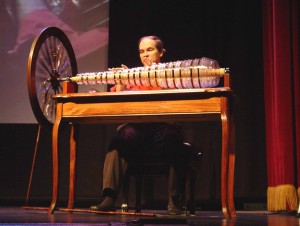
Dean Shostak playing the glass armonica.
I have to tell you that my favorite part of the visit had nothing to do with gardening. It was the Crystal Carols concert by Dean Shostak.
Shostak is one of only 10 people in the world who play the glass armonica, a curious instrument invented by Benjamin Franklin. It fell out of favor in the early 1800s.
The armonica looks like a long glass cone mounted on a small table. It’s attached to a fly wheel that’s operated by a foot pedal. The cone is actually a series of overlapping glass bowls. The player wets his fingers, makes the cone go around with the pedal, and then touches the spinning bowls to create the sound. Each size bowl makes a different sound. The principle is much like playing water-filled glasses, only in this case, the glass moves instead of the fingers.
Shostak plays Christmas music on the armonica as well as on a rare glass violin (only two of them in the world), a set of glass bells and on a new winged contraption called a cristal bachet that makes music by stroking glass rods.
The sound of all of these was unlike anything I’d ever heard. And Shostak is such a nice and humble man who played all of these unusual glass instruments so well while telling us the stories behind the instruments.
For instance, the armonica never caught on because it’s expensive (each bowl costs over $600) and so fragile to move. But it mainly lost out because so many past armonica players seemed to end up with mental problems. Turns out they were breathing in lead from the lead dust used to lubricate the flywheel in addition to absorbing lead that was in the glass back then.
For more on Colonial Williamsburg, check out www.history.org. And for more on Shostak, visit www.crystalconcert.com.



Comments
No comments